2014-04-19

Weekends 6, 7, 8 and 9 of Basic Training

I got a new job at Microsoft, moved to another neighborhood in Vancouver and met a new girl.  These events have kept me rather busy and I didn't find the time to write about my military training until now.  So, this post will present a condensed account of four weekends of training.

On the sixth weekend, we had two big exams.  One on Saturday morning and one on Sunday morning.  The first was a written one on all the theory we had seen that far.  It was pretty easy.  Nobody failed.  I got 100%.  The second one was a practical on marching drill.  Drill is my weakness and the exam made me nervous.  Just when I was about to do the exam, one of the staff members told me that one of my laces was undone.  I did't hear what he said at first, so I asked "What was that?" without terminating my question with his rank nor coming to attention while speaking.  Because of that, I was told to go back in line and do my exam after everybody else had done so.  When I came around again, things got worst.  When I was marching, I was told to turn to one side but, because of the acoustics of the drill hall, I didn't hear whether it was left or right.  I turned left (50% chance of being correct), but I had been asked to turn right.  Then my marching got all out of sync to a ridiculous point.  All that would have been bad enough but was made worst by the fact that all my fellow trainees had already completed their exam and were now staring at me bombing mine.  That was the lowest point of my basic training.  I, along with seven other recruits, failed that first pass.  We had remedial training that day and did the test again.  We eventually all passed.  Essentially, the system is "rigged" so that nobody can fail.  So I really didn't feel too hot not to have passed at my first attempt.

The seventh weekend, we had our weapon handling test.  I feel confident with the rifle, so this exam did not make me nervous.  However, during the exam itself, I forgot one safety precaution for one procedure.  That's an automatic fail.  So, again, I had to do a second pass before I successfully completed the exam.  That safety precaution is now forever ingrained in my mind.  Later that day, I read and signed my progress report from the previous week (which, after the drill incident, was bound to be bad).  Again, not the best weekend.  That Saturday, we were let go for the night as the unit where training is conducted was holding some dinner event.  Six of us from our section rented a suite nearby.  This was way more comfortable than sleeping in a cot in the armoury.  The next day, we learned about chemical, biological, radioactive and nuclear warfare.  We now have to wear our gas mask pouch on us at all times.  Whenever an instructor yells out "Gas!  Gas!  Gas!", we have to put our gas mask on (and our full hazmat "bunny suit" if we have it around too).  At the end of the day, while in such a simulated gas attack, we were told to bring our gear back to a specified room.  Then, when we did just that, we were asked who told us that the gas was clear and we were ordered to put the full gear back on.  Basically, the staff was toying with us.  The staff was yelling at us like a bunch of mad dogs.  I had a master corporal barking right at me while I was donning my gear.  It was a somewhat stressful way to end the weekend.

The eighth weekend, we went to the Jericho garrison for our training as the armoury where we usually train was holding another event.  Because of that, we didn't have training on Friday night.  We came in at 7:30, had breakfast and did two written exams.  Then, we spent the whole day learning the theory of land navigation with a map and compass.  We were let go around 17:00 and were allowed to go sleep back home.  The next day was much the same.  However, on Sunday, I was course senior.  That means that it was my turn to be the liaison between the students and the staff.  That's normally a position that comes added responsibilities and stress.  However, given that we were not in our usual armoury, we didn't have to do station duties (such as cleaning tables, the bathrooms and the floors) and the members of the staff I had to deal with were very relaxed.  I got off easy.

On the ninth weekend, we went close to Chilliwack (about an hour and a half east of Vancouver) to practice land navigation in a wooded setting.  We slept in big tents holding short of 20 people each.  Saturday morning, we had an overview of some field equipment such as gas stoves and lamps and some information on field hygiene.  There are no showers on the field, so that changes one's approach to cleanliness somewhat.  The rest of the day and evening was spent doing navigation.  The weather could not have been better.  Warm, sunny day followed by a clear, moonlit night.  We saw many deer.  It felt like a vacation of sorts.  Before going to bed, we were shown a white phosphorous flare and told how it could be used to zone in on enemies trying to approach a camp.  The next day, we went to a gas hut to get tear-gased.  This exercised was to gauge our ability to use the gas mask and gear.  We went in three times.  The first time just to confirm that we donned the gear on properly.  The second time to test drinking with a gas mask on (through a special tube that connects to our canteen) and replacing our mask's canister.  The third time was a bit more interesting.  It involved us walking in the gas hut without our mask on and putting it on only once we started feeling the effects of the tear gas.  For the first five seconds, it didn't affect me that much.  Then, just as I was beginning to think I might be immune to the effects, it hit me like a ton of bricks.  It really hurt.  Imagine having wasabi stuffed down your nose and eyes.  That's what it felt like.  Opening my eyes was close to impossible.  I fumbled a bit because of the pain and put my mask on.  With the mask on, it took about five minutes before the pain dissipated.  That was quite the experience.  After the gas hut, we headed back to Vancouver and unloaded the truck that carried the material we used on the field.  While doing that, a very beautiful mother came and asked us if she could take a picture of us with her two children.  We obliged.  Actually, downtown, many people took pictures of us.  Finally, I took the bus back home.  On it, a weirdo started talking to me.  The uniform attracts attention.  It also bounds you to be polite and considerate beyond reproach as it represents the Canadian Forces.  Because of that, I had to chat with the individual on the bus.


2014-03-11

Fifth Weekend of Basic Training

The fifth weekend of basic training took place two weeks after the previous one.  When entering the armoury, it felt like it had been months.

Our class of originally 37 people is now down to 35 candidates.  One is now doing the rest of the course in another city, and the other was accepted by the British Royal Marines and is leaving Canada to get his training in the UK.

This whole weekend was dedicated to first aid.  The whole class got certified.  The written exam was so easy that anyone could pass it even without taking the course.

One corporal from my home unit was an instructor during the weekend.

For some reason, most of the guys in my section kept farting on this one guy from the section.  It was the running gag of the weekend.

I'm currently house-sitting a friend's place and had to take the bus to get there.  I was wearing my uniform and carrying my gear.  At one point, one strange man with obvious psychological issues got on the bus and immediately started talking to me.  He was telling me about a completely made up story about a Canadian Forces soldier killing people in the suburbs of Vancouver.  Normally, I would just tell nut cases like him to buzz off.  However, when wearing the uniform, I am required to display exemplary behavior and be polite and courteous with all.  So, I had to spend my time explaining to this man that his story made no sense and that the members of the Canadian Forces are not here to harm Canadians but rather to serve them.

2014-02-12

Fourth Weekend of Basic Training

Again, I walked from home to the armoury with all of my kit on me to start my fourth weekend of basic training.  Friday evening, we had some marching and weapons drill practice.  We also had to meet, one by one, the course warrant officer and the course officer to let them know how we were doing and to get some feedback from them.  The course officer used to be a software engineer so he was interested in my civilian career.

Saturday morning, we had physical training outside in civilian gear.  It was -7 Celsius.  This is outrageously cold for Vancouver.  Many people didn't bring more than a t-shirt and a pair of shorts for PT.  After experiencing such cold, I'm sure they will bring more gear next time.  We jogged and did sprints for about 40 minutes before coming back in.  After PT, we had breakfast followed by our morning inspection.  Then, it was a whole day of class.  Topics covered varied from ethics and military ethos to dealing with interpersonal conflict and basic radio communications.  That night my section volunteered for fire picket duty so that we would have time to clean our weapons while being night sentries.

Sunday morning, we had a light rucksack "forced march".  The morning inspection was done by the course warrant officer and was done to a uniform standard across not only sections, but the whole platoon.  That didn't go too well as one section was completely different from the others.  Since it was the first section to be inspected though, all the other sections were deemed to be out of standard.  The rest of the day was spent revising marching drill, learning how to deal with hazardous material, learning new marching drill with weapons (which managed to get me confused) and learning how to deals with rifle stoppages.

2014-02-06

Third Week of Basic Training

The third weekend of my basic training was not as demanding physically as the second one, but it was more exacting overall nonetheless as instructors turned up the heat again.  On Friday, another guy was selected to be our section senior.  At first, he didn't seem quite comfortable with the role because as soon as we started referring to him as "section senior" and started asking him for instructions, he felt sick and actually went to the bathroom to deal with nausea and / or vomit!  But then things got back into place and he was able to go on.

Saturday morning, we did some physical training which consisted of crossfit-ish activities such as push-ups, leg raises, boxed jumps, burpees, doing the "moutain climber", planking and running around.  After half an hour of that, we stretched and cooled off before taking showers and getting dressed for the day.  Because of the lack of showers, as soon as the single female recruit is done taking hers, guys go the women's bathroom to take showers.  After each meal, each of the four sections of 9-10 individuals has to take care of one of the assigned tasks:  cleaning the tables, cleaning the floors, emptying the garbage cans, and cleaning the bathrooms.  This weekend, my section had the bathrooms.  After eating and cleaning, we had to get ready for our morning inspection.  This time around, the instructors really went into town.  For example, my duffle bag was zipped up and all its buttons were done up and its handles were laid up on top of it.  However, the handles were not tied together.  Because of this, I had to hold my duffle bag in front of me with extended arms for twenty minutes while the staff carried on with the inspection of the rest of my section.  Needless to say, my muscles failed.  Eventually, my section commander replaced the bag with my riffle.  This was lighter, so I could manage to hold my arms out with only that charge.  Still, it was far from pleasant.  After a total of half an hour, I can assure you I was very relieved when I was finally allowed to take my arms down.  But that relief was short lived as we were then ordered as a section to do planks.  Other teams had their share of fun too.  One section had a sergeant flip all the cots (with lots of equipment on them) over the floor and scream his lungs out at them.  I also saw and heard many boots fly around.  That was quite the start to the day.

Thankfully, the rest of Saturday was more relaxed.  We had classes on compensation and benefits with the Canadian Armed Forces, on the Canadian Honours System (orders, decorations and medals), and on physical and mental well-being.  This last part felt a bit a bit touchy-feely.  But at least we learned about available resources should we ever experience difficulties.  Also, an instructor gave an account of his personal experience with PTSD after returning from Afghanistan.  I am thankful for that as his testimony was much more real and informative than any video or text can be.  That night, we were told to go to bed half and hour earlier than usual.  I didn't get to benefit fully from that night, though, as I had fire picket duty.

Me on fire picket duty
The next morning, we were told to wake up 15 minutes later than usual.  Then we had another "forced march", this time with a small backpack filled with equipment on our backs.  After coming back, we were told to take a shower, get dressed and be ready for breakfast in 15 minutes instead of our usual half hour.  After breakfast, we had our morning inspection.  Because of the extra 45 minutes of sleep and because our time was cut in half to get ready after breakfast, our inspection turned out to be disastrous.  I'm pretty sure that is what was intended by the instructors.  So we got yelled at for half an hour.  Once that was over, we moved on to a morning of training on marksmanship and riffle combat drill.  After lunch, we had marching drill, this time with our weapons.  Finally, we were let go early this Sunday (shortly after 4 pm).  Maybe this had something to do with the Super Bowl.

2014-01-28

Second Weekend of Basic Training

After receiving my full kit of gear and clothing at my unit and having a weekend off, my basic training resumed.  The heat was turned up a bit on this second weekend of training.  Right after coming in on Friday night, we had a physical training session which consisted of various exercises, most of them focusing on the legs.  It was quite painful for me as I had gone to the gym earlier that day and had worked out my legs.  The innumerable squats and lunges we had to do that night were grueling.  That weekend, I volunteered to be my section's senior.  That means that throughout the weekend, I was to have increased responsibilities such as communicating and insuring the completion of requests from the staff.  One of my tasks consisted of writing a fire picket roster.  When the instructors saw my list, they judged my handwriting to be so bad that the whole class had to do push-ups.  After that, I had other people transcribe my notes to the staff.

Before going to bed, we had some time to get our kit ready for the following morning inspection.  We usually joke around a bit when we have "almost-free" time like this.  A guy in my section took a picture of another, modified it with an app on his phone and, wanting to send it to another section member, mistakenly sent it to a member of the course staff!  This was both hilarious and scary (because of the potential fallout).  [The following week, the recruit who sent the picture was "written up" and had to write a 250-word essay on ranks and discipline.]

Picture mistakenly sent

This time, we had cots to sleep in.  However, I didn't get to use mine too much on the first night because I was assigned "fire picket" duty and had to stay awake as a sentry.  As a result, I only went to bed at 3:30 am.  Then, at 4:00 am, the idiot in my section woke me up to know who he should wake up to replace him as fire picket sentry while it was completely clear who it should be.  In fact, it was so clear that even he managed to figure it out (only seconds after asking me).  Then, at 5:00 am, it was time to wake up for the day.

At 5:30, we went out on a walk with our combat uniforms, tactical vests and helmets on.  This was our first so-called "forced march".  We will have many until we get to one in which we'll have to carry 25.4 kg (just short of 60 lbs) of equipment over 13 km under two hours and 24 minutes.  This weekend's march was peppered with some other exercises.  I was already hungry the night before because of all the exercise.  The march made me even hungrier.  We came back around 6:30 and had to shower and get ready for breakfast at 7:00.  We all ate like ogres.  At 7:30, we had a kit inspection and got yelled at until past 8:00.  As section senior, I had to note down the deficiencies of my section's members so that they be addressed in the future and tracked by the instructors.  The rest of the day, we did some marching drill and learned about the administrative and disciplinary measures that can be taken to address behavior and performance issues with members of the Canadian Forces.  We also learned how to properly use many of our kits items such as rucksacks and sleeping bags.  Then we got basics about Canadian military law and how to treat / be treated as prisoners of wars.

The next morning, we had a physical training session outside, which consisted mostly of torturing our already sore legs.  For 40 minutes, we ran up and down stairs, hopped up stairs, did stationary wall squats (not pleasant), stationary leg raises and a plethora of other exercises.  Then, back in the armoury, we stretched and did some yoga-esque cooling off.  Following breakfast, we did the most complicated marching drill session to date and then moved on to learning more about the C7 rifle.  Before lunch, we were told that we weren't fast enough and that we were wasting the staff's time.  As punishment, we had to eat on the floor on our bellies with our tactical vests and helmets on, facing away from each other.  Usually meals are some of the most fun parts of the weekend.  This one wasn't.  We finished the day learning more C7 material (how to clean the rifle, how to adjust the scope, how to load/unload magazine and so on).  Throughout the day, we felt pain in our midsection from all the planking and stationary leg raises as well as in our quadriceps.

2014-01-14

Boot Camp Begins!

This last weekend was the first of my 11-weekend part-time basic training with the Canadian Armed Forces (i.e. my boot camp).  I must admit that I felt nervous before starting because of the unknowns and because of how some of the people back at my home unit described boot camp as a highly unpleasant experience.  At any rate, I showed up at the British Columbia Regiment armoury in downtown Vancouver slightly before 19:00 on Friday.  The location has special meaning for me because a few months ago I lived right in front of that building.  Once inside, we registered in and were divided into four sections of about nine individuals each.  Each section was then assigned a section commander and a second in command from the training staff.  These assigned staff members then guided us through the inventory and labeling of our equipment (which I have yet to receive) and instructed us to write autobiographies to get to know more about us.  I was also told never to bring the Canadian Forces boots I had bought at a surplus to training again.  Mixing of military (or even military-looking) gear with civilian gear is frowned upon.

At 23:00, it was lights out.  We slept in the sleeping bags that are part of our equipment kit.  Those were placed on the kit air mattresses which themselves lay right on the armoury floor.  The vast majority of us didn't get good sleep that night.  It's hard to sleep in such an odd place as an armoury especially when surrounded by 36 other people and when an extremely noisy heating system kicks in and out every five minutes.  All nights, two recruits must stay awake to perform "fire picket" duty (that is, to keep watch).  The recruits are relieved by two others every hour.  This isn't too bad if you get the first or last shift, but totally disrupts your night otherwise.

Saturday, we were given an extra half hour of sleep and got up only at 5:30.  We had a morning inspection to make sure we were properly shaved, groomed and dressed, and that our kit was in order.  Given that we only have two showers for 36 guys (the single female recruit gets a bathroom to herself), I just skipped my shower that morning - as many did for that matter.  After the inspection, we were told to wash our hands and to line up for breakfast.  Before getting breakfast, we had to do five chin-ups.  For the vast majority, that was nothing.  But for some it was clearly a challenge.  For them, basic training will be hard and long (if they make it through).  Breakfast was pretty hefty and was served by the training staff.  When it was my time, I was asked whether I wanted pancake or French toast.  I said "French toast" but the master corporal gave me a pancake.  When he was giving me the pancake, I thought he was making a mistake and I repeated "French toast".  He didn't change a thing, just smiled and said "Here's your French toast".  I wonder if the reason he purposefully gave me the pancake was just to randomly screw with me or whether it's because I only said "French toast" instead of "French toast, master corporal".

After breakfast, we had classes on the rights, obligations and objectives of military personnel in Canada; on the rank structure and on what to do in case of fire.   Those falling asleep were instructed to follow the classes while standing at the back.  We were also introduced to the notion of rotating section and course seniors, who are recruits with increased responsibilities with regards to the flow of activities of the course candidates.  Lunch was again very generous.  The portions given are always bigger than what I generally eat.  However, I haven't taken the chance not to eat my whole plates so far.  Despite that, I have always had dessert because there are so many options to choose from and I have a sweet tooth.  We were also told that if we left an empty juice container at the drinks table, it would be 100 push-ups.  After lunch, we practiced drill.  I now know what part of basic training I like the least.  After dinner, we were each issued a C7 rifle (a variation of the M16) and were told to memorize its serial number and never let it get out of arm's reach.  All recruits had one-on-one meetings with their section commanders or second in commands to discuss the contents of the autobiographies and exchange feedback.  After the lights were out, I went to shave (so as not to have to do it at the same time as everybody else in the morning) and then managed to find a thermostat that controls half of the heating system in the armoury.  However, with one half shut down, the other half was still more than enough to be disturbing.  Undisturbed, though, was the guy sleeping right next to me.  He was snoring, which only compounded my personal difficulty to fall asleep.

At 5:00 on Sunday, it was time to wake up.  We put on PT clothing.  I had a t-shirt and sweat pants on.  Others had similar outfits or were wearing shorts.  Then, when we were told we would start PT with a run outside, I understood we wouldn't get the chance to put more clothes on before doing so.  It was the first time I ever ran a few kilometers in a 3 or 4 degrees environment.  At first, it goes without saying that it was chilly.  After a while, the running itself gave me enough heat to tolerate the cold better.  Still, next time, I'll put gloves in my sweat pants' pockets and will wear something with long sleeves rather than a t-shirt for PT.  Back from the run, we did as many push-ups as we could in two minutes, then as many sits-up as we could in two minutes and then planked for as long as we could.  This was to assess our fitness and, I'm guessing, to use as personal benchmarks for future comparison.  After PT, we were ordered to take a shower, shave, dress and be ready for breakfast.  We were given 30 minutes to do so.  There are only two showers.  We are 36 guys.  Needless to say, this was a massive dose of unsought "intimacy".  Also, with so many people taking showers, the hot water ran out.  Even if you had all the time in the world to shower, you wouldn't want to take it.  At breakfast, there was a choice of pancake and waffle.  I wanted a waffle.  But I wasn't asked for my preference and was given pancake again.  With rifles assigned to us, meals are different.  Every time there is a meal, we all line up our weapons in one area and two recruits are posted as weapons sentries to watch over them.  Two relief sentries are chosen and eat before everyone else.  As soon as they finish, they go replace the first sentries who can now go eat.

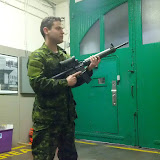
After breakfast, my favorite part of the weekend came around.  We had training on the C7 rifle:  its specifications, how to handle it, how to ensure it contains no bullets, how to disassemble it, how to re-assemble it, and how to ensure it is in working order.  After that, we had to clean the bathroom and do drill again.  Finally, we cleared and cleaned the armoury (so that it can be used by its unit during the week) before being dismissed until the following weekend.  The first weekend was not nearly as bad as I thought it would be.  Then again, the instructors did tell us they were trying to assess whether being relatively permissive and lenient on the first weekend would lead to better outcomes in the future weekends, when they will turn up the heat.  After leaving the armoury, I felt free like a prisoner would feel when being released from jail.  Walking back home, the next thing I noticed is how many (beautiful) women there are in "the real world".

These are the main points of the weekend's schedule.  However, a big part of what made the weekend special was the interaction with the people.  First, there is the staff.  They obviously are there to instruct you and give you a harsh time.  I am happy that my section's staff is focused more on instructing than on giving us a hard time.  Some instructors are tougher than others and we get flak for an increasing amount of reasons from most of them.  Meals are nice occasions to socialize with fellow recruits.  I can see myself becoming friends with many of them.  Going to the bathroom can also present a social aspect.  We are 36 guys and there is only a single toilet bowl.  Once I went in the bathroom to pee and this guy was taking a dump and being very loud and vocal about it.  Others in the bathroom peeing or brushing their teeth had various reactions.  The whole thing felt like a sociology experiment.  One guy said "Dégeulasse!", which is French for "Disgusting!".  Originally being from Montreal, I talked to him in French.  I didn't expect to meet another guy from Quebec in my basic training.  He's the only one I know in Vancouver.  Our whole group is blessed by the presence of a man who already served in the Canadian Forces decades ago.  He decided to come back and has to do basic training again because his former training lapsed.  He's a treasure trove of helpful hints and indications on what to do to smoothly perform during training and beyond.  Another person who stands out is the only female recruit.  I'm afraid she doesn't stand out for the right reasons.  She's in her mid-forties and was way behind everybody else in the morning run.  She's training to be an officer but doesn't seem to have the combination of energy, motivation, stamina, knowledge and leadership to fulfill that role properly.

Of course, the closest relationships are those with members of one's own section.  The guys in my section are pretty much all decent.  Most are actually pretty cool and would/will surely make great friends outside training.  We are nine in my section.  If I said pretty much all are decent, it's because one isn't.  He's the class' "Gomer Pyle".  He can't dress properly no matter how many times he gets his appearance flagged and no matter how much the section tries to help him.  Despite the instructors repeating many times for him, he cannot strip/re-assemble his C7 rifle properly.  He's often missing or late when his presence is required and seems to be overwhelmed and lacking in motivation.  On the second night, before falling asleep, he told me he was homesick and missed his mom!  (I am not kidding)  I doubt he will make it through basic training.  In my opinion, the sooner he quits the better.  He is currently a liability to the section and the whole class.  Also, I absolutely would not feel comfortable with a guy like him carrying weapons or representing the Forces.  Still, as long as he's in my section, I'll try to instill some sense into him and limit the drag he brings to the group.  That being said, I have to reiterate that the vast majority of the guys in the class seem like capable, hard-working fellows.  I even overhead one instructor saying to another that our class was pretty good.  So, with some effort, the wrinkles will get ironed out, and this will prove to be an enriching experience.

2014-01-05

Enrollment & The Start of My Military Career

In 2013, I applied to become a reserve officer with the 39th Combat Engineer Regiment in North Vancouver.  I'm writing how the recruiting process went for me both to share my experience with others in case that proves useful for someone, and also as a reminder for myself of these events.

I've always been drawn to the military.  As a boy, I felt like many others a playful desire to be a soldier.  As a teenager, I noticed that desire faded in most.  However, I still was fascinated by the armed forces.  As a young adult, though, I chose a civilian engineering career.  Engineering because I like technology and civilian because I enjoy my freedom.  As years went by, I felt I wanted more than a regular office job.  I came to consider joining the reserve to realize a dream of mine without sacrificing what I had achieved so far.

After spending much time on www.forces.gc.ca, army.ca and various other sites pertaining to the military, I finally applied online on 2013-03-19.  Then, for a couple of months, nothing happened.  Once a recruiting form is submitted online, no feedback is available at all for quite a while.  However, on online forums I learned this is normal and that the only thing to do at this point is wait.  So this is what I did.  Then, in June, I got a call from a recruiter from a squadron located at the other end of the province trying to confirm that I wanted to join that squadron.  After explaining to her that she was mistaken and that there must have been some miscommunication, she told me someone else would be contacting me shortly.  A week or two later, a member of the New Westminster Canadian Forces Recruiting Centre contacted me.  He told me that as a reserve applicant, it was my responsibility to contact the reserve units myself to find out whether they had open positions and then to go apply in person at the unit that interests me the most.  I found it strange that no centralized tally of open reserve positions was being kept, but I proceeded to contact all the units that interested me.

From the get-go, I wanted to have the role of Engineer Officer.  Very few officer positions are open in the reserves.  I was lucky that one was with the 39th Combat Engineer Regiment in North Vancouver.  The recruiting officer there told me that I had to meet her at the North Vancouver armoury to proceed further.  When I went there, I had to sign a statement of understanding to attest that I knew what I was attempting to get into.  I was also told there was some problem with the online application system and that it wasn't really being used.  Because of that and despite what is written on the Forces' official website, the way to go was to submit all the forms at the reserve unit.  I had to re-fill and re-submit everything that night.  I also had to provide all my supporting documents (birth certificate, transcripts, etc.) again.  Good thing I had brought them with me.

Then, essentially nothing happened for the next two months.  I would have gotten no feedback at all again if I had not emailed the unit recruiter a few times.  It is worth mentioning that recruiters don't seem to have business cards.  So if you want to communicate with them, you should make sure to ask them for contact information.  Another way to get a hold of someone is to remember that usually the email address of Forces members is of the following form:  first_name.last_name@forces.gc.ca.  So two months later, I was scheduled to write the CFAT.

The CFAT is taken at your local recruiting center.  Upon arrival and before writing the CFAT, the candidates have their paperwork double-checked.  Some will need to make corrections.  Also, the candidates have to fill a form regarding past and current (recreational) drug use.  Then, it's on to the test itself.  The CFAT consists of three parts:  a vocabulary section, a spatial section and a mathematical section.  I have written the GMAT before.  I would say that the CFAT vocabulary and math sections are easier than that of the GMAT.  Another way to put it is that those who feel the need to prepare for the CFAT can use GMAT preparation material.  Having prepared extensively for the GMAT, I did well on that test.  Thus, I went through the CFAT's vocabulary and math sections with ease.  However, the GMAT doesn't have a spatial ability section.  For this reason, I found myself less prepared for this section of the CFAT.  One note:  making sure to give a decent stab at all the questions is better than getting sucked into spending too much time on any one figure and lacking time to properly analyze others at the end.  Right after doing the test, you will be told whether you got a score sufficient for the position for which you applied.  If you did, you will be scheduled for a medical test.  At any rate, you will also be reimbursed for your transportation to the Canadian Forces Recruiting Centre.  This will not be the case your future trips to the recruiting center.

I was booked for my medical two days after my CFAT.  The medical started with a questionnaire on my health history.  Then my height and weight were measured.  Following that, I was given a vision and color test.  For the last element of the first half of the medical test, I entered an acoustically sealed chamber and did a hearing test.  For the second half of the medical test, I moved to another room.  This part of the process at first resembled what you'd expect from a regular medical check-up:  breathing in and out with a stethoscope on your chest, opening your mouth and saying "ah", having the person peak into your ears and so on.  However, in addition to this, I was asked to do a few movements such as a couple of push-ups, touching my toes with my fingers, crouching, "walking like a duck" while crouched in an odd way.  This is to verify that you have no handicap in your range of motion.  I'm happy to report that throughout the whole medical exam, I got to keep my shorts on.  No one played with my balls on inserted anything anywhere uncomfortable.  I was also surprised that I didn't have to provide any blood or urine sample.  I thought the Forces would have wanted to run some basic tests on those and also screen for drugs.  I was told that in the past there were so many false positives with those tests that it wasn't worth bogging down the medical recruiting staff unless there was a reason to believe such tests were necessary.  In addition, random drug tests can be administered at any time while you are serving.

After the medical, the next step is the physical test.  I was told however that the person who was conducting physical testing at this recruiting center had recently left and that I would not be able to do the physical until a replacement was found.  I was told this could take a while but was assured that I would be contacted as soon as a replacement was found.  One month later, having gotten no news, I contacted my file manager at the recruiting center to know whether they had found a replacement.  She told me one had been found... a few weeks ago!  Good thing I checked up on my file or I might just have fallen into the cracks.  So I ended up doing my physical test a bit over a month after my medical.  The physical was essentially the EXPRES test:  cardio, push-ups, sit-ups, hand grip.  The guy who oversaw my physical test was strongly reminiscent of Bill Murray.

A few weeks after completing the physical, I was scheduled for a job interview.  The officer who gave me the interview reviewed my file, asked a few standard HR-ish questions from a form he was filling on me and made me sign some papers.  Some of the questions I was asked were "Why do you want to join the Forces?", "Why the reserve and not the regular Forces?", "Why did you choose the specific occupation you did?".  The papers I had to sign included a statement saying that I accepted to be subjected to military law and an affirmation that I would not use illegal drugs.

Then, I thought I was out of the woods but I wasn't quite yet.  I informed the recruiting officer at my local combat engineer squadron that I was all processed and awaited further instructions from her.  She told me that it wasn't certain there was an Engineer Officer position available after all.  Needless to say, I found it quite strange that candidates would be sent through the whole recruiting process if it isn't clear that there is a need for them.  Thankfully, a few weeks later I was informed that I was now authorized to be enrolled.  However there was still one last hitch.  I wasn't guaranteed a spot on the next basic training session.

Regardless, I showed up at 6 Engineer Squadron's armoury on 2013-12-12 to be sworn in.  That night, I had loads more of paperwork to complete before being sworn in.  Then, I pledged allegiance to the Queen of England in a solemn affirmation that marked my official enrollment in the Canadian Forces.  One interesting point:  because I joined through the direct entry officer program, I was enrolled as an Officer Cadet with an immediate promotion to the rank of Second Lieutenant.  This is common for DEO officers, but I still find it strange that just because one has a bachelor's degree, one can get commissioned without even having completed basic training.  At any rate, following the swearing in, my body measurements were taken in order to get gear that fits me.  Finally, I got to enjoy a few drinks in the mess after having completed my first three paid hours in the army that night.

All in all, it took roughly nine months for me to get in the army.  Throughout the whole process, the information I got from various sources (for example, the Forces' official website, the recruiting center personnel, my squadron's recruiter) was inconsistent if not outright contradictory.  I am told this is the norm and that my processing time was actually quite decent.  I am saying this so that those considering joining understand that the army isn't an efficient corporation but rather an arm of the government.

On the bright side, I got enrolled two days before the holiday party and got to enjoy a memorable experience then.  (Think military ceremony mixed with alcohol, a good meal, rough games and getting to know the people in my squadron)  Also, shortly after, I learned that my spot for the upcoming basic training has been confirmed.

I'm looking forward to learning new skills, experiencing life from another angle and contributing to the Forces.

2013-12-07

Crossing Borders Illegally from Argentina to Brazil / Paraguay

Yesterday was my first full day in the Iguazu Falls region.  I had arrived the day before from Buenos Aires by plane and had gathered information about this area and about how to move around its different parts.  So, after waking up early and eating a little of the crappy (but free) breakfast served where I was staying, I took a bus at the Puerto Iguazu bus station around 8:30.  The bus marked "Paraguay" was operated by "Cruzero del Norte" and cost 20 Argentinian pesos (around 2 USD) to board.

I must admit that I was a little nervous.  After all, my plan was to enter in both Paraguay and Brasil illegally, that is, without going through customs and immigration, and without paying the "reciprocity fee" of 160 USD that Canadians are required to pay to enter legally in Paraguay, nor getting the expensive (~80 USD) visa Canadians must get to legally enter Brazil.

At any rate, the bus I was in looked like a typical city "colectivo".  Judging from the looks of the people on board, I was the only passenger who wasn't from a Mercosur country (that is, the only one who would normally have needed to do something special to get into Paraguay).  We picked up a few more passengers on our way to the Argentinian border exit control.  For some reason, all the countries in South America I've been to control not only entries but also exits.  Because of this (and to re-enter Argentina upon return), I brought my passport.  At the border control, we all went off the bus, got our papers inspected and/or passports stamped and then were promptly on our way.

Back on the bus, we crossed the Iguazu river over a bridge and into Brazil.  I was nervous at that point because I feared we would be controlled at the Brazilian border as well.  However, since our bus was headed to Paraguay and was not meant to make any stops in Brazil, we simply entered the country without stopping at the border.  This is all very lax and people can and do stop in Brazil all the time.  So, if you are in Argentina and want to go to the Brazilian side of the Iguazu Falls (without paying for a Brazilian visa), you can simply take the bus to Paraguay from Puerto Iguazu (in Argentina) and get off in Foz do Iguaçu (in Brazil).

But my intention was to go to Ciudad del Este in Paraguay first and then go to the Brazilian side of the Iguazu falls.  Therefore, I enjoyed reading the signs in Portuguese while in Brazil until we reached the Puente de la Amistad (Friendship Bridge) which links Brazil to Paraguay.  Actually, most of the trip from Argentina to Paraguay takes place in Brazil.  Crossing over the bridge is slow as it is chock full of cars, trucks and buses, many of them making their way across to benefit from the lower prices and taxes in Paraguay.  That border crossing is a real joke.  So many people cross that bridge, but few (if any) get controlled at the border.  The bridge is a huge conduit for smuggling (either of legal goods to avoid duty fees, or of outright illegal goods).  I got in Paraguay without needing to do anything particular.  Just like everybody else, I just got in.

Entering Paraguay
Shopping starts right at the border in Paraguay

From what I experienced in Ciudad del Este, I'd venture to say that Paraguay is a crap country.  Once inside the country, some of the passengers on my bus got off (before we got to the bus station) with contraband they had stashed under their seats.  One lady had enough stuff to fill a car.  I'm guessing those goods are later headed to Brasil.  Later, after completing the trip, I saw people living in squalid conditions around the bus station.  These people were living in dwellings constructed out of discarded wooden pallets and garbage bags.  Going back to the center of the city (which is basically where the bridge to Brazil is located), I saw hordes of people peddling cheap products and/or knockoffs everywhere.  This is the kind of place where taking the bus means people come in and try to push crap products on you or beg money from you at about every city block and where walking around means it's likely you'll stumble upon a dirty child flat out sleeping on the pavement of a sidewalk.  It's also worth noting that US dollars, Argentinian pesos, Brazilian reais and Paraguayan guaranis are accepted as currencies of payment for just about everything.

Ciudad del Este

When I grew tired of the chaotic poverty and of the hustle and bustle, I decided it was time for me to head to Brazil to see the Iguazu Falls from that country's side.  As I was walking my way to cross back over the bridge, a motorcycle taxi driver approached me and asked me if I wanted a ride to cross.  He asked for 5 Brazilian reais or 3 US dollars.  I'm sure I could have haggled over the price, but for such amounts, I didn't feel like bothering.  So I donned a helmet and we zig-zagged through the traffic over the bridge, avoiding other motorcycles going in all directions, and circumventing trucks and cars.  I must confess that I held on tight as some of the maneuvers my driver did seemed quite dangerous for the North American driver that I am.  On a few occasions, I also felt my clothes and my boots touch cars.  There was no border control back into Brazil.  One has to wonder why Brazil is so open at that border.  So much tax revenue is lost on smuggled goods.

Once in Brazil, I hopped on a bus that took me to the urban transit terminal next to the Bosque Guarani Zoological Park in Foz do Iguaçu.  From there, I took bus 120 straight to the falls (for less than 2 USD).  Before doing so, however, I went to an ATM, got some Brazilian reais and changed most of them to Argentinian pesos at a rate way better than the official one (as Argentina artificially maintains the exchange rate for its currency at nearly double its real worth).  I was happy to be back in a country where the government is not interfering so recklessly with the economy.

My dealings with the local population in Brazil were confusing in this sense that after a month of being in Spanish-speaking countries, my mind is used to interpreting and expressing itself in the language of Cervantes.  Brazil, with its Portuguese, was similar enough yet different enough to mess up with my Spanish.  That was interesting.

Iguaçu Falls (Brazilian Side)

Anyway, I visited the falls and played with some coatis.  Then it was time to go back to Argentina.  I took another "Cruzero del Norte" bus right next to (but not in) the urban transit terminal in Foz do Iguaçu.  Thankfully, there was a tourist information desk at the transit terminal that pointed me to the stop.  As the bus made its way back, I was nervous again.  Would there be problems at any border?  When we exited Brazilian without stopping at the border control, I felt a bit lighter.  Again, since that bus is not really meant to stop in Brazil, no checks are made from the authorities of that country.

Coatis

There was only one hurdle left:  Argentinian immigration.  As I said before, normally countries in South America stamp you out when you leave them.  I was afraid the Argentinians would ask me where I had been after I left the country and give me trouble.  To make it easy for the lady at the counter and to not give her too much time to think about my case, I prepared all my papers neatly and opened my passport at the page where my last Argentinian exit stamp was.  Typical of border agents, she had an austere look on her face.  After seeing my exit stamp, she proceeded to go through my passport page by page, examining each of them carefully.  Then, she asked her colleagues to come and look at my passport.  At that point, I was tense and was preparing to get grilled.  But then she said in Spanish to her co-workers, "The new Canadian passports are pretty cool; they have different pictures on each page"!

That was it; there was no problem at all!  I felt relieved and moved on with a warm, fuzzy feeling inside.  After I got back in Puerto Iguazu, it started pouring cats and dogs.  Thankfully I didn't have the rain bothering me during that adventurous day.  As usual, the gods had been with me all along.

2012-02-28

Back in Vancouver

Again, I haven't written in a long while, mostly because I was too busy traveling around, and then because of the master's degree I undertook.

Again, I won't bother writing about my past stories because I feel they are old and stale by now. This means I won't write a post on what's good about Paris to counterbalance my previous blog entry.

After I left France last summer, I visited the following countries: Finland, Estonia, Sweden, Norway, Denmark, Portugal, Spain, Morocco, Andorra, Italy, Switzerland, Germany, Austria, the Netherlands and Belgium!

This brings the total number of countries inc which I've been to 34. Here's my personal international coverage map:


In my European adventure, I enjoyed Estonia and just loved Spain. Germany, Austria and the Netherlands are awesome too.

I now have a backlog of well over 10,000 pictures to process one way or another, some day or another.

After my glorious summer in Europe, I flew back to Montreal just long enough to pick up my stuff and go to Vancouver, where I am now doing a master's degree in finance. I haven't traveled much since September, given that grad school is keeping me quite busy. I did take some time to visit family in Hope, BC for Christmas and spent a few days in Seattle as well.

On a different note, with Facebook and other similar sites, blogging loses some of its significance. What I posted in the past was mostly for people somewhat close to me. However, given that they probably are in my list of Facebook friends anyway, I've decided to change the focus of my blog.

Instead of simply writing about my trips, I'll cover whatever I feel is relevant to potential readers on the web.

2011-06-26

What's Bad About Paris

Warning: this post is just a looong regurgitation of negative impressions I had in Paris. For a more upbeat entry, skip to the next one in this blog.

The days leading up to my summer-long European expedition were stressful because I wasn't just leaving for a long trip; I was moving out of the city for good. However, on the day of my departure, I felt serene.

Quickly after landing, I got the impression that the Parisian region is just like a giant Bronx. There are lots of graffiti all over the place, palpable racial tension and lots of shady characters. Paris has that dog-eat-dog dynamic. It does have an American ghetto vibe. Just like in lower-income American neighborhoods, there are many Blacks, but the Latinos are replaced by Arabs from the Maghreb. Throw in some Eurothrash elements from the crappier countries of the EU and hordes of tourists, and it becomes very difficult to find ethnic French people in Paris.

It is obvious that France has issues with its immigration policy and social integration. That country seems to put more value on its immigrants speaking French than on them having specialized skills or capital. This leads France to welcome many people from its former African colonies who don't bring much to the country's social and economic fabric. This fosters xenophobia from the ethnic French who come to equate immigration with the degradation of their society. Sensing this perception, immigrants are easily alienated. No wonder Paris experienced racially charged riots a couple of years ago.

Contrast this with the Anglo-Saxon working model for immigration and social integration in which anybody bringing in skills or money is welcome. This less ethnocentric model is faring way better in countries such as the UK, Canada, Australia, New Zealand and even the US.

I am tempted to attribute France's social failures on its insistence in having immigrants speak its hard-to-learn language of limited global relevance. However, countries such as Denmark, Sweden and Norway have languages which are harder to learn and even more useless on the global stage, yet they more successfully (but far from perfectly) integrate immigrants into their societies.

Whatever the causes of France's social discordances, one thing is for sure: French civilization is on the decline (in case you had not noticed anything in the past 200 years).

Aside from the macro trends, here are some anecdotal cases of degeneration which I noticed during my week in Paris. Once, a guy was headed towards me on a collision course in a metro station because he wasn't looking where he was going. I put my arm in front of me in case of an impact and veered off to avoid him. When he saw my raised arm, he deliberately pushed me. I had to contain myself in order to do the reasonable thing and go on my way rather than satisfy my instinct to start a fight. On another occasion, I was walking towards a metro station when this guy asks me where it is located. I tell him I'm going there and that he can follow me. He tells me he's a Bengali refugee and quickly follows by saying that he can give me a satisfying "massage" if I'm interested! I just left him behind. On yet another metro trip, this apparently drugged up Maghrebian ghetto kid was drinking, singing and smoking on the train. Again in the metro, I saw this gang of half a dozen kids seemingly pickpocketing their way from wagon to wagon. Pickpocketing is a real problem in Paris with metro train conductors sometimes announcing on the PA system that thieves are operating in the current train. When it's not pickpockets, it's buskers who come on the trains with guitars or even trumpets and blast their way around for donations. Equally annoying are the beggars who come on the trains. There are so many of these pests because PEOPLE GIVE THEM MONEY!!!

Similarly, you'll find tons of hawkers near tourist sites. I wonder, first, what people dealing with beggars, buskers and hawkers are thinking. Don't they know that giving them money only encourages them to continue being nuisances for a living? Then, I wonder why the authorities are not doing anything to deal with these people. With the sheer number of these social parasites, the government could make millions handing out fines and it would go a long way in making Paris more pleasant. Many of the culprits also seem like illegal immigrants. I'm sure individuals would be less eager to peddle souvenirs if it meant possible deportation!

Then there are the scam artists operating all over. The classic scam consisting of following the marble under one of three cups being switched around is common. And one must keep an eye out for Gypsies. I had heard of them before as being the scum of Europe. Seeing so many of them pulling quick ones on tourists or trying to pity people out of some change, I understand how they got such a nasty reputation.

Then, you have the policies that don't make sense. France is notorious for its bureaucracy. Many things that could/should be simple are complicated in France. This is endemic both with the government and corporations. For example, you can walk into a grocery store with only one cash register open and a long line-up of people. Then you see half a dozen self-checkout stations but can't use any of them because two are reserved for some sort of food stamp program, two are reserved for holders of a certain card and two are hogged by people trying in vain to use the machines.

Corporate policies that don't make sense are one thing, but at least they punish the corporations pushing them. Bad government policies, on the other hand, just hurt the people. France is rife with those. France banned head scarves. This is manifestly targeted at Muslims. While I find head scarves to be ugly and religions (especially the Muslim one) to be stupid, I can't find any justification in having a government dictate what to or not wear. And ostracization doesn't do any good for cultural integration.

More government insanity... During my week in Paris, the government has banned any mention of Facebook and Twitter on television saying that such mentions constitute hidden advertisements. WTF!? First, mentioning a service you use is not advertisement. Second, you should have the right to advertise whatever you want. Third, this is censorship. Fourth, France is painting itself in a digital corner. Now, I don't know if this rule applies only to publicly funded television stations or to all stations. Regardless, it is retarded.

With such "logic", no wonder one needs to explicitly request for doors to open on the metro. Geez.

I'm sure it's another stupid government policy that makes it so that there are no convenience stores in Paris. Hell, I'd even go as far as saying there is no convenience at all in Paris.

And it's not just the shops... Sidewalks are too small and you are always cramped for space. It's the same on the metro. Apartments are tiny and overpriced. Food is expensive. Everything is expensive.

Why pay so much to be in such a place? Is it because it is beautiful? Except for a few nice, oversized spots that are not practical to walk through in every day life, Paris is much the same all over: old six or seven story masonry buildings. It quickly becomes boring.

So why would so many people pay so much to live in such a place? Well, I'm not personally convinced living in Paris is such a great thing, but it isn't all bad. More on this in my next post...

2011-06-16

Between Asia and Europe

I haven't been very diligent with my travel blog. In my last entry, I left off in Hong Kong. After that, I went to Shenzhen, Guangzhou, Chengdu, JiuZhaiGou, Shanghai, Suzhou, then on to Nagoya and Tokyo before finding my way back to Hong Kong and flying back home to Montreal.

Later, for the new year, I spent a week in Cuba, spending most of my time in Havana seeing how people deal with life in a highly controled communist economy.

Then, during spring, I went back to good old New York, Toronto and Boston.

All this before my 3-month trip to Europe. I don't feel like detailing those previous trips at this point so I'll just write down the impressions from my current peregrinations in Europe...

2010-10-17

Hong Kong

These events took place on the first week of August 2010.

It took me nearly 24 hours to travel from my apartment in Montreal to my hotel in Hong Kong. Nothing much to say about my arrival day in Hong Kong as I went to bed pretty quickly. I did notice that, unlike in North America, metro cars are all seamlessly connected, giving the impression of being in one long, infinite metro. Also, women have different fashion and some look pretty nice. One was talking to a gweilo (White man) on the metro who was telling her bullshit about not being a shallow man who can just hook up with any woman he just met in a bar because of his values and health concerns. To me, it was clear the reason this guy can't pick up women in bars is because he's just a plain loser. If he were in North America, he would never have the chance to talk to a quality lady like the one he was addressing on the metro car. I guess being White and exotic in a foreign land does have its advantages.

The next day, I went to the Hong Kong office of the company I work for. I'm officially on vacation, but I got to go away for one month in exchange for agreeing to work a reduced amount of hours during that time. It's a win-win: I get to travel longer and my company gets to keep me to take care of urgent issues while I'm gone. I figured a convenient location to work from would be the company's office. It would give me a feel of what it is to work in an Asian city and a chance to meet distant co-workers who actually did email me previously for work-related issues.

The Hong Kong office is small compared to the Montreal one, but has just been recently expanded. Thus, I got to benefit from having "my own" cubicle. I also got to meet big bosses of the Asian division of the company. The view from the office is on a dense urban forest of condo and office towers. I had lunch with co-workers, who told me about aspects of our business in Asia, about the local culture and about what to see and do in Hong Kong. After lunch, a few of the people in the office burped shamelessly. I thought it was funny because no one would dare do that in North America, especially in such tight quarters where everybody can identify the perpetrator of such bodily noises.

Then, I went to the Hong Kong University of Science and Technology because I was interested in one of their programs. The university is in the New Territories, relatively far from Hong Kong's downtown core. It has a campus in a picturesque location, but its buildings - like most of Hong Kong's - are drab and uninspiring, looking aged and cheap.

Having obtained information about the program of my interest, I headed further into the New Territories to Sai Kung to eat some sea food. Many restaurants are competing against each other in Sai Kung. All display the live fish and various animals they offer. Some also threw horseshoe crabs on the ground so that they could crawl around and lure customers in. It worked for me as I was looking to eat something different. However, I soon discovered that the horseshoe crabs are nothing more than marketing devices and that actually eating them is not something the restaurants intend you to do. When I asked how much it would cost to eat one, I was told it would be 300 Hong Kong dollars (roughly 45 Canadian or American dollars) and that only a minute amount of meat could be drawn from this creature. So, I opted for more "traditional" protein instead.

After dinner, I headed to Lan Kwai Fong for some drinking and to take in the cheerful spirit of the partying masses of expats. In LKF, the wise thing to do is to buy alcohol at a 7-Eleven and drink on the streets.

The next day, I went all over HK island and Kowloon. Amongst others, I entered the infamous Chungking Mansions. Come evening, I went to Lamma Island, about a 15-minute ferry ride from Hong Kong island. It felt like being in a completely different country. Instead of the busy, hurried pace of the city, the place was filled with a tropical resort ambiance. People lazily having fun and enjoying life in a leisurely way. Walking in this unlikely little paradise was much fun. Beautiful lanterns, local fauna, the sights and sounds of calm night bliss... I decided to make a hike of it and go all the way to the other side of the island. This took about an hour and a half. I was almost at destination, when a dog blocked my way in a very dark point of the path. I almost didn't see it. But when I did, I noticed it was looking straight at me with expectation in its eyes and a somewhat confrontational attitude. I'm not sure exactly what the dog wanted, but I felt threatened. I looked around me to see what I could do about this situation. I saw and picked up a 2x4 that was lying next to the path. Just that was enough to make the dog flee. Moments later, a local saw me with the beam in my hands and said not to worry about dogs here. The Lonely Planet guide says otherwise. I didn't take chances.

I had dinner at a restaurant on the island while waiting for the ferry back to HK island to arrive. When I took it, I went on the upper deck under an awning to admire the night even though it was raining, windy, and more comfortable inside. I enjoyed just being there in the night, on this small stretch of sea half a world away from home.

2010-03-14

The Games are Over

Been busy lately. Didn't take the time to write about the rest of my Olympic experience.

Here are the highlights...

Good weather graced Vancouver. I even got lightly sunburnt from walking in the warm winter sunshine of that city, which is normally rainy in February.

My friend from Montreal who wants to buy property in Vancouver arrived. We went to Toshi's together. The food is always good there and I suggested she try the oysters as they gave me a nearly religious experience the first time I had tried them there. Everything went well except that later that night, my friend discovered she is allergic to oysters. She ended up being all red, full of rashes and throwing up. At one point, it looked serious enough to consider a trip to the hospital. But once the food was out of her system, things got fine.

The next day, we both went to an Olympic hockey game. It was the men's semi-final, pitting the US against Finland. The Finns got their asses kicked real bad. In the first period, the Americans scored six goals. The Finns managed to score one in the last period. Not the most entertaining match ever. Nonetheless, I can now say I've attended an Olympic event! Later, the Finns would manage to get the bronze medal in hockey. Following the match, we walked around Vancouver and went to eat at Guu. I missed the atmosphere and food at this favorite place of mine.


Saturday night, I hung out with two friends from Montreal: Grace and Ling. The streets were filled with people. Although, because of the light drizzle, it wasn't as crazy as the previous night. One group of people was particularly funny. They were a hodge-podge of persons gathered through the encouragement of Decentralized Dance Party. They added to the general happy chaos reigning on the streets of Vancouver.

Another group of people who grabbed my attention was girls having a pajama party behind a shop's window. I'm guessing this was a kind of publicity stunt. A few people gave in to their voyeuristic instincts to look at pretty girls playing strip poker publicly. One guy next to me gave them something to look at, too. Yes; he whipped out his schlong and rubbed it against the window for all the ladies to see.

The following day - Sunday the 28th of February - was the most intense day of the Olympics. Not only was it a beautiful week-end day outside, but it was the day the US and Canada would face off for men's gold in hockey. I watched the match on TV (and I never watch any sport on TV). It was one of the best matches of the history of that sport. The teams were of comparable strength and skill; the action would constantly move from one end of the rink to the other; the score was always tight and the excitement more than palpable. Canada was leading 2 to 1, but after having swapped their goaler for an extra player on the ice, and 24 seconds before the end of the third period, the Americans managed to tie the score. The tension was really high. The game went into overtime and would be won by the first team to get a goal. Sydney Crosby, became Canada's national hero when he scored. The crowd entered in pure jubilation and the whole city, if not the whole country entered in a frenzy of pride en joy. The men on the American team looked like they were thinking about suicide. I can only imagine what they felt like, but they nonetheless gave a terrific performance.

If the streets of Vancouver had been crazy in the past weeks, it was nothing compared to what they were after Canada's win in men's hockey. I've never seen so many Canadian flags before. I've never heard so many people sing "O Canada" before. Vancouver was turned into a sort of Canaday Day party on steroids, with Halloween elements thrown in for good measure. People would climb lamp posts, would honk madly, would shout, sing and dance. Many were dressed in red, some actually wearing flags as their outfits. Some were costumed as athletes. Some didn't make any sense but were just damn funny (inflatable sumos, people on stilts, an East Indian playing the bagpipe, etc.) It was something to be seen and experienced.


I had dinner at Zakkushi on Denman that evening. I highly recommend this Japanese grill diner. After dinner, I just soaked in the energy from the joyous crowd until around midnight.

The next day, Vancouver was a lot more calm. The games were over and they had been quite eventful. Not only did they have the usual sport competitions, expressions of support and manifestations, but the also went further than usual on the dramatic side. For the first time in Olympic history, an athlete died while practicing his sport at a competition venue. Joannie Rochette, a figure skater, lost her mother days before her Olympic performance. As in a movie, that didn't stop her, but instead gave her that more reason to perform. And perform she did: beating her personal record, she managed to get a medal. Of course, during the games, countless records were broken. And so were the hopes of a Canadian athlete of finishing first in men's 50K cross-country skiing. After giving his best for nearly three hours, he finished second a mere two seconds behind the gold medalist. To fall behind by two seconds after giving yourself out to the point of breaking for three hours in front of the world has just got to be devastating. And that's how the American hockey team seemed to have felt after the most epic hockey game ever in which they lost the gold to Canada. But, one man's hell is another's heaven and Canada was given the sweetest win it could ever hope of getting. A perfect end to a brilliant streak of triumphs where Canada raked in 14 gold medals in total, the highest number ever won by a single nation in all the Winter Games. Hell, it even makes me feel patriotic to some extent and I normally can't be caught giving a damn about such vain things as national pride.

But all good things come to an end and I headed to the Pacific Central train station to catch a bus that would take me to Seattle, where I would take a plane back to Montreal. It reminded me of the time I lived in Seattle and would take the bus or train every week-end to Vancouver.

Crossing the border was made fun by our Korean-born bus driver. He told us that the Americans were too poor to buy garbage cans or to have toilets in the border post. He obviously was making fun of the Americans' ridiculous misplaced obsession with security. There was an American journalist sitting not too far from me and she was outraged to hear the guy talking like that. She insisted on letting people around her know that her country had enough money to buy garbage cans and hire people to pick their contents up. For a journalist, she didn't seem to have a firm grasp of sarcasm. The bus driver also told us that we couldn't take fruits into the US; not even banana peels or apple cores. He told us not to put banana peels or apple cores into the bus' garbage bags because the garbage bags was meant to cross the border with the bus. He said we had two choices: we could either eat our banana peels or declare them upon which the customs agents would confiscate them and eat them themselves. I should have given that driver a tip for making me smile that much. He's got the right attitude. To paraphrase the old adage: if life throws bananas at you, you make a banana split.

Once in Seattle, I visited my old workplace and saw my old amazon.com co-workers. After that, I went to Uwajimaya to buy Japanese plum wine to bring back home and I had dinner with Heng and Pathoum who came all the way from Everett to see me. Later, I took the fairly recently-built light rail train all the way to the airport and caught my flight back to Montreal.

Getting back to Montreal made me feel like I do when I visit second world countries. Compared to Vancouver, Montreal is dirty, aging, haphazard, poor and ill-mannered. Of course, it's not quite Paraguay, but I don't see anything holding me back to my hometown. What my trip to Vancouver made me fully realize is that I can remotely work from anywhere. So, after I take some more time to figure a few things out, I might just become a world rambler, a citizen of the Earth with no specific address who just roams the planet in search of adventure and making the most of what little time I have in this life.

2010-02-21

Second Olympic Week

During my second week in Vancouver, I met a few friends and we updated each other. All had interesting stories.

I went to a victory ceremony with one friend. During that ceremony, the always funny-looking Shaun White from the US was given a gold medal for snowboarding. Also, Christine Nesbitt (a Canadian), got a gold medal for speed skating. Being a Canadian, she got the crowd going crazy when she accepted her medal. After the ceremony, I had dinner with my friend and we talked about Life (career, love, cities...) until 1am. I thought she looked better than ever and was disappointed when she told me she now has a boyfriend as I wouldn't have minded at all to be hosted in her Yaletown condo...

The next day, I had lunch with some old co-workers from Nexon in Gastown. I then visited the new game studio where they now work. After that, I went in the Oakridge area of Vancouver to check out a guest house for a friend who'll be staying in Vancouver for a month to look for a property to buy.

Given that the friends at whose places I thought I would be staying in Vancouver after my time at my first host's place sort of flaked out on me and given the fact that I didn't want to overstay my welcome at my first host's place, I decided to move to the guest house. My property-buying friend will be staying for a month and by including my stay as part of her reservation, I get to pay for the time I stay at the monthly rate rather than at the daily rate.

Guest houses are one of Vancouver's secrets. There are basically houses owned by a family in which people can rent rooms or suites. One can easily rent a room for under $40 a day (even during the Olympics) in guest houses. The reason many people don't know about them is that they are run mostly without permits and whatever revenue they generate goes undeclared. Most of them cater to newly landed immigrants from China. If a guest house has a website, it is likely to be in Chinese only. Google "family guest house" Vancouver or family house hotel Vancouver and you'll find the sites of a few that have English versions. The one where I'm now staying is conveniently located next to a SkyTrain station and a shopping center; offers free Internet and cable TV and has all the amenities you would expect to find in your house. It website is located at http://www.linsinn.com/ . Use Google Translate to understand what it says.

After checking out the guest house, I went back downtown to walk a bit with a friend around Stanley Park and then eat some Japanese food. Then, I took the SkyTrain all the way to the suburb of Surrey to attend a free Sam Roberts concert. When I got there, the show had already started, but the best songs had yet to come and it turned out to be a great concert. The crowed was very much enthused and the sweet smell of weed was all over the place.

After coming back downtown, I walked a bit on Robson and Granville streets. The streets were PACKED. I've never seen Vancouver that excited and exciting. It felt like a Canada Day party gone out of proportion. People drinking on the streets, shouting "Go Canada!", flaunting they stuff or just walking around to "bathe" in the crowds.

I met two girls that were very suggestive in their way of dressing and their attitude. I had a few drinks with them and then walked around downtown with them. They were funny, but not nearly as funny as noticing guys' stares in their direction and blatant sexual interest in them. Life as a sexy girl must have many benefits.

Speaking of lovely ladies... Vancouver is chock full with them. Not only is there a dazzling variety of Asians, but the Caucasian girls here make me renew my interest for white girls. Amazing blondes, slim anglophones, fitness enthusiasts and rich ladies from all over the world visiting for the Olympics. People in Vancouver are not afraid to wear shorts and flip-flops all year round. So, it comes as no surprise that despite this being February, the array of tight leggings and bare legs I saw in the past two weeks beats months of Montreal's "Winter Collection".

Not only is Vancouver a city I enjoy living in, but it also provides all these beautiful, educated and affluent women. Maybe Vancouver truly is my destiny.

At any rate, this Saturday, I met some more friends and we basically wasted our time waiting in line for events we never got to attend (the venues were full). Then, on Sunday, I had a Nippo-Korean all-you-can-eat experience at Shabusen on Granville street with John (an Amazon co-worker) and his wife. Then, I walked some more downtown and came back to my place to rest a bit.

2010-02-16

The Games Are On

Last Friday, I went to a venue with large screens to see the opening ceremony. To get the privilege to stand in the rain to look at those screens, I had to wait in line for an hour. And that's because I'm lucky. Some waited over two and a half hours and did not even make it in.

After two hours of watching the ceremony, I got tired and exited the venue to join an old co-worker and some of his friends nearby.

The next day, I walked around the downtown area some more and went to see the Olympic cauldron with its flames near the convention center.

I got tired of Vancouver's winter weather (rain). Ever since I got here, it has been raining. The city has been constantly enshrouded by thick, dark clouds. Imagine, in the middle of the afternoon, your camera will automatically turn its flash on when you take pictures outside. Wet and depressing.

On the other hand, I've never seen Vancouver so busy. For Montrealers out there, imagine a bunch of events in numbers surpassing the Montreal Highlights festival and crowds like you'd find during the Jazz Festival. Bars, stores and restaurants strategically located are making a killing. I even saw people lining up to go inside a liquor store on Robson Street.

On Saturday, the gods were with us and we got a gorgeous, sunny day in Vancouver. The weather hovered near 15 degrees Celsius. I went to Chinatown to see whatever activities were happening there due to the Chinese New Year. I didn't see much that changed my life. I then basked in the sun for a good hour wearing no coat in this charming park. I then walked all around False Creek to look at the various pavilions. I tried the new streetcar to go to Granville Island.

Then, I met this Mexican girl. She wanted to "hook up" because it was Valentine's Day and she's going back to her country soon. I felt bad, but I had to turn her down even though this would have been so easy. There was just no connection nor attraction. Mark this down as another crappy Valentine's Day, for the both of us.

After that, I went to Richmond for "the biggest Chinese New Year celebration this side of Beijing". I saw a traditional lion dance, martial arts demonstrations, singers and fireworks. One kid doing a martial arts demonstration busted his knee while not landing correctly from a jump. He must have felt awful. First, to bust a knee is never cool. But to do so in front of a humongous crowd is even worst. I bet he's scarred for life.

I met an old Amazon co-worker and his wife at the celebration. We talked a bit and they brought me back to where I'm staying.

Every night, there are fireworks in Vancouver for the Olympics.

Going around all over the metro area like this makes me re-discover just how beautiful this city is. I don't want to go back to Montreal. I feel more at home here. It's quite possible I'll move back to Vancouver. Remains only to figure out when and under what circumstances...

2010-02-12

Olympic Fever Starts Rising

I did lots of walking around downtown Vancouver. Went back to many places that have some significance to me. Although, one could see the Olympics were coming, the city wasn't as bustling as I expected.

Then, Thursday night, I went outside to see the Olympic flame makes its way in downtown Vancouver. So many people were outside waiting for it.

I got to see it from pretty close. People were definitely excited. As soon as the flame would be past a group of people, they would start following the runner. By the time we got to David Lam park, where the flame was to reside, the crowd was huge.

After a cauldron was lit with the Olympic flame, there was some music, some fireworks and visuals.

Today, I haven't gone out yet, but I know there is more action going from the constant buzz of the helicopters ahead.

I'll head to the Yaletown Livecity venue in David Lam park for the opening ceremonies in a few hours.

Vancouver is shedding its sleepy nature for a while!

2010-02-10

Back in Vancouver

I landed in Vancouver Tuesday night. I quickly felt a poignant mix of emotions. I was sad to have left this city in the first place but glad to be back. Many memories came to surface. Hints of couldas, shouldas and wouldas. I took the new SkyTrain line straight downtown and arrived to the apartment of the first friend to host me during the Olympics. It's in the West End, close to where I used to live. The nostalgia was mixed with curiosity for all the new things, including a crazy dancing set of spotlights in place for the Olympics.

2009-10-26

New York & Google's Verdict

After a couple of days in Philadelphia (see last post), I took a bus to New York City. Normally, it takes about an hour and a half to do that route. However, it being a Friday afternoon during rush hour, my journey lasted more like four hours.

Living from moment to moment, I had no hotel reservation for that night. I figured luck would smile at me and I'd spend the night at some hot honey's place or something. So, I went to the hotel where I would stay the next night to put my baggage in storage.

Once that was done, I went to join Shoji (who I know through a grade-school friend) for supper along with some of his fellow English school classmates:

Shoji's classmates were interesting with diverse backgrounds and coming from all over the place: Germany, Spain, France, Korea... For some reason, they were all female. A couple of them made me wish they'd be the one to keep me from having to find a room at a hotel...

After dinner, some of us went club hopping. One of the places we landed in is 230 Fifth. Apparently, it's quite the popular place these days. It does have a nice rooftop garden from which you can admire New York's skyline in all its splendor while sipping down cocktails and martinis.

At 4:30am, the party was over and I didn't have a place to stay. I walked a bit and saw this dude in a phone booth, pretending to be on a call so that he could take a piss there. I went to an Internet cafe to check my emails for a couple of hours (some people were sleeping there) and then went to my hotel, where thanks to my contact there, I was able to check in early and rest until a certain point in the afternoon. The rest of the day, I just did some light exploration.

New York felt different. I had always felt home there. But this time, the city made me feel lonely and it kept showing me things that reminded me of the girl with whom it didn't work in Vancouver. Maybe home isn't a specific place, but rather where your heart is.

The next day, I did some more walking in Manhattan before joining a German friend I had first met in New Zealand. She came to visit the US along with some other German girls. While I was sitting on some stairs, waiting for her in front of the Rockefeller building and thinking about life, a man came pretty close to me, stopped, aimed his SLR camera at me, slowly adjusted its settings and then took a shot of me. It was odd because I knew he was taking a shot of me and knew I knew he was taking a shot of me. Around the same time, a woman was scolding her boyfriend over her cellphone and telling him how much of a jerk he is. Love isn't easy.

The Germans finally arrived and we went to "The Top of the Rock" (the observatory at the top of the building in the middle of the Rockefeller Plaza). After that, we went to Inakaya, a Japanese izakaya restaurant located at 231 West 4oth. It's an animated place where the staff shouts all the time, the chefs hand out food with long tools so as not to have to leave their post and where the patrons are made to participate in the fun in such ways as beating the crap out of rice dough.

Once I came back to Montreal, I realized I had a voice message from Google's recruiter. I got very nervous. Even though I had tried not to set any expectations, I had let myself become convinced at some level that I would get the job. When the recruiter told me it wasn't the case, I was devastated.

Google isn't just a place where to work. It is THE place where to work. Getting the job would have vindicated me from destiny, in a sense. It would also have given me a place, I believe, where I would have belonged; a family of sorts.

In short, Google isn't just a job, it's a destiny.

Perhaps I'm putting too much faith in that company and am idealizing it as a sort of panacea to overcome my personal shortcomings, but I still feel that my life, despite not being bad at all, has fallen short of my dreams. The question now is what do I do with my existence?

2009-10-17

From Silicon Valley to Philadelphia

On my last night in California, I walked about a bit. I saw a HUGE store dedicated solely to Halloween merchandise. I went in and felt right at home in the middle of all this eerie stuff. It reminded me of the feeling I had on Halloween nights as a kid. I was amazed that a store could be economically viable by selling only seasonal things like this. Some of it was pretty advanced and expensive. Life-size animatronics talking and doing macabre maneuvers, funny and raunchy costumes, devices one wouldn't dream of... It never ceases to amaze me how there seems to be a market for everything in the US. I had a similar impression when I walked into a liquor store with a selection far beyond anything I've ever seen in Canadian state-owned shops and with quantities of material that make you wonder again just how stores survive in the US given that there are no houses around.

The next morning, I went to San Jose's airport and flew to Philadelphia, through Phoenix. Given the flights' durations, the layover and the time zones, I got in Philly just in time to go to bed.

I remember the first time I went to Philadelphia. I thought it was just a domain full of overweight, undereducated ghetto-dwellers. It does have more than its fair share of those, but it's got so much more. The first time around, I didn't invest enough time to discover the place.

Philly's basically made up of three parts: the historic district, the downtown core and the "Europeanish" section.

In one day, I walked over 40 kilometers and gave my feet bad blisters, but I saw so much. In the historic district, I saw (again) Independence Hall, where the colonies declared independence from the Crown of England. I also saw the Liberty Bell, parks, the United States Mint for coins, colonial buildings, Edgar Allan Poe's House, Benjamin Franklin's grave and many other things.

The downtown core has a diverse set of architectural styles. From very old buildings to the ultra-modern Liberty Plaza and the Comcast Tower. The city hall is the biggest piece of masonry on earth (whatever that means) and sits right next to a huge Free Mason's temple. Close to the city hall, many public statues can be seen, including the famous "LOVE" one. South Broad Street, south of city hall, is really magnificent to see at night with its inventive displays of colorful lights highlighting the countless artistic events taking place.

Then there is the Benjamin Franklin Parkway, which is basically a "Champs-Élysées" right in the middle of Philadelphia. It gives a noble and French feel to a whole part of the city. It's terminated on one end by the Philadelphia Museum of Art, sporting a neo-classical look that adds to the effect of grandeur. This is where Rocky ran up and down the stairs to train and where a statue of him now shines for tourists to see.

No visit to Philadelphia is complete without sampling a local cheese steak sandwich. I went to
Pat's King of Steaks, where the sandwich was invented. It's a Philadelphia staple. Many stars, politicians and Important People have been there, as evidenced by the numerous autographed pictures. There's always a line-up for the sandwiches. The people working there have a curt and rough attitude that makes New York cab drivers seem polite. I think it's all part of a show. Good sandwiches, though!

All in all, Philly's not too bad. I could see myself being trapped there for a year or two.